The Weave Begins

Overview

The handloom sector of Northeast India is not just an economic activity—it is a centuries-old tradition that reflects the culture, identity, and collective memory of its people. Every woven fabric carries stories of communities, rituals, and generations of artisans who have preserved this craft with patience and skill. For thousands of families across Assam, Meghalaya, Manipur, Mizoram, Arunachal Pradesh, Nagaland, Tripura, and Sikkim, weaving is both a livelihood and a legacy.

Despite this richness, the sector today faces multiple challenges. The younger generation is gradually moving away from weaving due to low and uncertain earnings. Traditional designs, while beautiful, are often not aligned with contemporary markets, leading to limited demand and stagnant incomes. Artisans also struggle with poor access to technology, organic dyeing solutions, and safe working conditions. Issues of ergonomics, eyesight, and mental health further impact their productivity and quality of life.

Recognizing these challenges, this three-year initiative was conceived as a bridge between tradition and innovation. It blends research with practical action, bringing together academic insights, design solutions, and grassroots engagement. The goal is not only to protect the heritage of weaving but also to create new pathways for artisans to thrive in changing social and economic landscapes.

Aim

The broader aim of the project is to ensure that the handloom sector of Northeast India not only survives but flourishes as a resilient, respected, and sustainable livelihood option. At its heart, the project envisions a future where artisans gain dignified incomes, where their cultural identity is preserved, and where traditional weaving becomes a source of pride and prosperity for younger generations. The aim goes beyond economics—it is about creating a holistic ecosystem in which artisans are healthy, empowered, and equipped with the tools and knowledge to respond to modern markets while staying rooted in their traditions.

Objective

The core objective of the project is to strengthen the handloom sector in Northeast India through a comprehensive and participatory approach. Unlike projects that stop at research or limit themselves to small-scale interventions, this initiative combines field surveys, design trials, product development, training workshops, and artisan well-being programs under a unified framework.

The idea is to engage artisans directly, understand their lived challenges, and co-create solutions instead of imposing top-down models. By focusing on product quality, market readiness, sustainability, and artisan health, the project aims to generate real, tangible improvements in the lives of weavers. At the same time, it seeks to document knowledge and practices that can influence future policies and inspire replication in other clusters.

In short, the objective is both transformational and sustainable—to uplift artisans economically, socially, and culturally while ensuring that the unique weaving traditions of the Northeast continue to flourish for generations.

Funded By

The initiative is generously supported and funded by the North Eastern Council (NEC), Ministry of Development of North Eastern Region, Government of India. NEC has played a pivotal role in guiding the development journey of Northeast India by promoting inclusive, balanced, and sustainable growth across all eight states. Its focus has always been on harnessing the region’s strengths—be it natural resources, cultural heritage, or human potential—while addressing deep-rooted socio-economic challenges.

By funding this project, NEC has reaffirmed its commitment to the preservation and promotion of the handloom sector, which is both an economic lifeline and a cultural identity marker of the Northeast. The Council’s vision is clear: development must not come at the cost of tradition, but instead empower traditional sectors to thrive in the modern economy. This project thus reflects NEC’s long-standing mission of combining innovation with inclusivity, ensuring artisans receive the recognition, training, and resources they deserve.

Duration

The project spans a three-year timeline, carefully designed to allow for both depth and continuity.

Collaboration

Bringing Traditional AYUSH Healthcare Closer to Our Weavers

At IIT Delhi, we believe that the well-being of our handloom weavers is just as important as preserving their craft. Many weavers, especially women, balance long hours at the loom with caring for their families and children, often putting their health last.

To help address this, our Handloom R&D Project in Assam has joined hands with the Central Council for Research in Homoeopathy (CCRH) and the Central Council for Research in Ayurvedic Sciences (CCRAS) under the Ministry of AYUSH , Government of India . This collaboration brings traditional, trusted systems of healthcare — Homoeopathy and Ayurveda — directly to weaving communities in clusters like Sualkuchi .

Homoeopathy and Ayurveda offer natural, gentle, and effective treatments for everyday health problems — from body aches and stress to chronic conditions. They are affordable, safe, and easy to continue alongside daily work . For women weavers who rarely have time to travel far for treatment, these services are now available nearby in their community .

One of the most crucial aspects of this effort is raising awareness. Many people are not fully aware of how traditional medicines can help them stay healthy naturally and cost-effectively. By organizing free health camps, regular OPD services with subsidized medicines, and wellness workshops, the project team is helping weavers and their families learn about these options and make informed choices for their health.

Through this partnership, we aim to ensure that the artisans who keep India’s vibrant handloom traditions alive can care for themselves and their families without worry — staying healthy, strong, and hopeful for the future.

Strengthening Market Linkages: Our Collaboration with NEHHDC

To uplift the livelihoods of handloom weavers in Assam, the Handloom R&D Project at IIT Delhi is working in close partnership with the Northeastern Handicrafts and Handloom Development Corporation Limited (NEHHDC) — a Government of India enterprise under the Ministry of DoNER.

This collaboration brings together the best of technical research and market development, helping weavers bridge the gap between traditional skills and modern market demands. While our R&D team focuses on loom improvements, ergonomic support, dyeing innovations, and community well-being, NEHHDC strengthens the effort by providing practical marketing support, digital tools, and product traceability solutions.

Under this joint initiative, more than 1500 weavers from Sualkuchi and 200 weavers from the Hahim Cluster — identified through our detailed surveys — have been connected to NEHHDC’s large-scale program, which reaches over 10,000 weavers across the Northeast. To date, 262 IoT devices/QR codes have been installed in the Sualkuchi Cluster and 117 IoT devices/QR codes have been installed in the Hahim Cluster. These tools help authenticate handloom products, ensure traceability, and build buyer confidence in genuine handmade textiles.

Additionally, a three-day capacity-building workshop titled “Designing for New Horizons” was recently conducted for the weavers. This program focused on:

  • Innovative design techniques for regional and global markets
  • Understanding market dynamics and production quality standards
  • The benefits of GI registration and how to use the NEHHDC app
  • Practical tips on using facilities like “Yarn on Wheels”
  • Technical insights on IoT devices and digital marketing through platforms like ONDC

These hands-on sessions are designed to equip weavers with the right tools, skills, and knowledge to grow their craft sustainably and connect with wider markets.

By combining IIT Delhi’s research-driven solutions with NEHHDC’s strong marketing and technology outreach, this collaboration ensures that our weavers’ work reaches its true value. Together, we are building a support system that protects authenticity, improves earnings, and keeps the rich legacy of Assam’s handloom tradition alive and thriving.

Collaborators and Investors

We are a team comprising of faculties and researchers from IIT Delhi and IIT Guwahati who have worked on different areas in the Handloom sector and who can be potential contributors in the development of this sector.

Prof. Mukhopadhyay has been associated with the handloom sector for the last ten years. He has worked with the Chirala clusters, Andhra Pradesh, Bengal Muslin clusters, Bardhaman West Bengal, and Khamir region, Gujarat. He has been working on technological interventions in the handloom sector.

Prof. Wazed Ali is in the textile chemical processing group and works in the fields of dyeing and finishing of textiles. He has worked on projects of eco-friendly finishing.

Prof. Sougata Karmakar is associated with the well-equipped ‘Ergonomics Laboratory’ at the Department of Design, IIT Guwahati, and continuing his research work in the field of Ergonomics/ Human Factors. He has also worked with the handloom sector .

Handloom Clusters

We reached out to six major clusters across Assam— Sanpara (Rani BLC), Sualkuchi, Hahim, Digaru (Dimoria Block), Bongshar, and the Haropara Organic Dyeing Unit. We organised awareness camps, held counselling sessions, and spent time in one-to-one conversations with the weavers to gain a deeper understanding of their lives.

A detailed baseline survey was also conducted—not as a formality, but as a tool to deeply understand:

  • How involved each cluster is in handloom work

  • The everyday struggles they face—financial, social, and emotional

  • What keeps them motivated despite these challenges

  • Where they need the most support to thrive

Stories from the Clusters

  • Sanpara (Rani BLC)

    In the quiet villages of Sanpara, weaving is mostly done part-time. Many weavers here work long hours just to meet household needs, earning as little as ₹2,000–₹4,500 a month from selling gamochas and mekhala-chadors. Traditional designs still dominate, and while some dream of trying new techniques, the lack of marketing connections and resources holds them back.

  • Sualkuchi

    Famous as the “Manchester of Assam,” Sualkuchi is alive with the rhythmic sounds of thousands of looms. Weavers here create exquisite silks, but rising yarn prices and outdated designs make it harder to compete in wider markets. Many still work under master weavers, hoping for better opportunities to stand on their own.

  • Hahim

    Home to the Garo and Rava communities, Hahim is a village where weaving is part of everyday life but rarely seen as a full-time livelihood. The weavers here are talented, yet unaware of Government schemes that could change their futures.

  • Digaru (Dimoria Block)

    In Digaru, weaving is mostly for family use. Younger generations are slowly losing interest, as they see limited scope in handloom work. With better design training and market links, this could change.

  • Bongshar

    Just 27 km from Guwahati, Bongshar is a buzzing hub for silk weaving. But even here, weavers face tough competition, limited margins, and almost no presence in bigger markets.

Haropara Organic Dyeing Unit

Haropara is a small but inspiring story. Here, Mr. Normohan Das has been practicing organic dyeing for over 15 years. His beautiful eri silks travel as far as international buyers, but he dreams of passing his knowledge to more weavers and scaling up his work with better tools.

Across all clusters, one truth stood out: weavers need more than just skills—they need opportunities.

  • Most are still weaving part-time, struggling to balance other work and family needs.

  • Traditional designs dominate because new design training is scarce.

  • Few weavers have direct market access; middlemen often take the larger share.

  • Awareness of Government schemes is extremely low.

Primary Focus Cluster: Sualkuchi

Sualkuchi is situated on the North Bank of mighty river Brahmaputra and is about 35 KM from Guwahati city. Sualkuchi is famous for its century old weaving activity. The weavers here are engaged in weaving Muga silk, Eri (Endi or Erandi) silk, Tassar silk and Mulberry (Pat) silk. The fabrics woven are Silk Mekhala (Lungi type for ladies) chadors (half saree type), Sarees, Stoles, Gamocha Assamese (towel). Handloom weaving in Sualkuchi is said to date back to 11th Century. Over the years Sualkuchi developed as a weaving village. The weavers in Sualkuchi hail from neighboring districts of Assam i.e., Nalbari, Gossaigaon, Bongaigaon, Barpeta etc. Both tribal and non-tribal weavers work in this cluster. The population of Sualkuchi Development Block is 70,962 and total number of weavers is 19,530 with 16,975 handlooms.

The R&D team during survey at Sualkuchi observed that the Entrepreneurship model (Mohajan) is prevalent here. Under this model most of the weaver’s works under Master weavers or entrepreneurs/traders/Mohajan. The small-time entrepreneurs/traders own 2 to 15 handlooms which are set up in the backyards of their households or in some rented premises in the villages. The established entrepreneurs/Master weavers possess 15 to about 60 handlooms and such looms are housed in weaving sheds where the weavers work on contract terms. Currently Sualkuchi weavers use pre dyed yarns for weaving. Bulk of the required yarns are sourced from Karnataka. Muga silk filament yarn is locally sourced from Upper Assam itself. Tassar filament yarns are sourced from outside the state. Of late weavers are also using polyester yarn. They weave Polyester yarn in the warp and the weft are Tassar silk yarn. Use of Muga silk yarn is at its lowest owing to the sharp rise in price (Rs.28,000.00 and above per kg). The weavers have now introduced weaving of scarves and stoles of Eri silk yarn. Synthetic dyeing was in practice for dyeing Mulberry, Muga and Tassar silk yarns about a decade ago but now such dyeing of yarn is not done here. Few weavers have started dyeing of silk yarn with natural dye mostly using plant’s leaves, roots and barks etc. The organic dyeing activity is in its initial stage only.

COVID pandemic compelled a sizeable number of weavers and master weavers to shut down their weaving activities. They reported to have sold their produce at loss to traders to get back at least some portion of their investment. Bulk of the finished products is sold to traders in Assam including Central and Upper Assam districts. Some sarees and dress materials are also sold in West Bengal. Demands in West Bengal increases during the Durga Puja festival. In Assam Silk Mekhala-Chador and Sarees are a must for marriage ceremonies and the weavers also produce the fabrics to meet the seasonal demands.

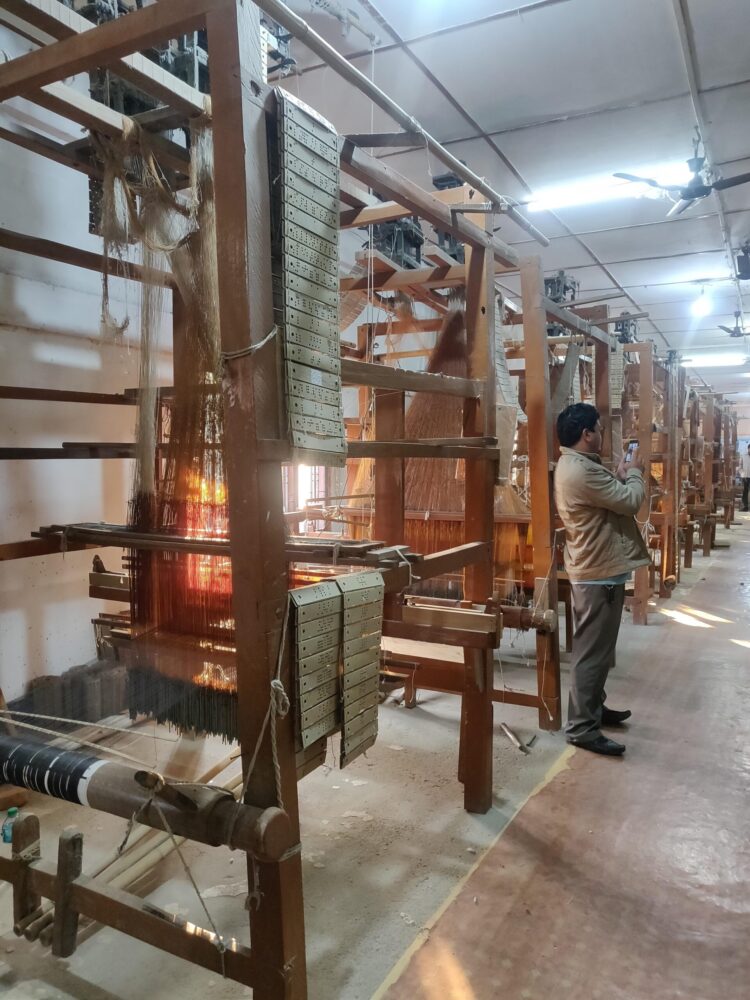
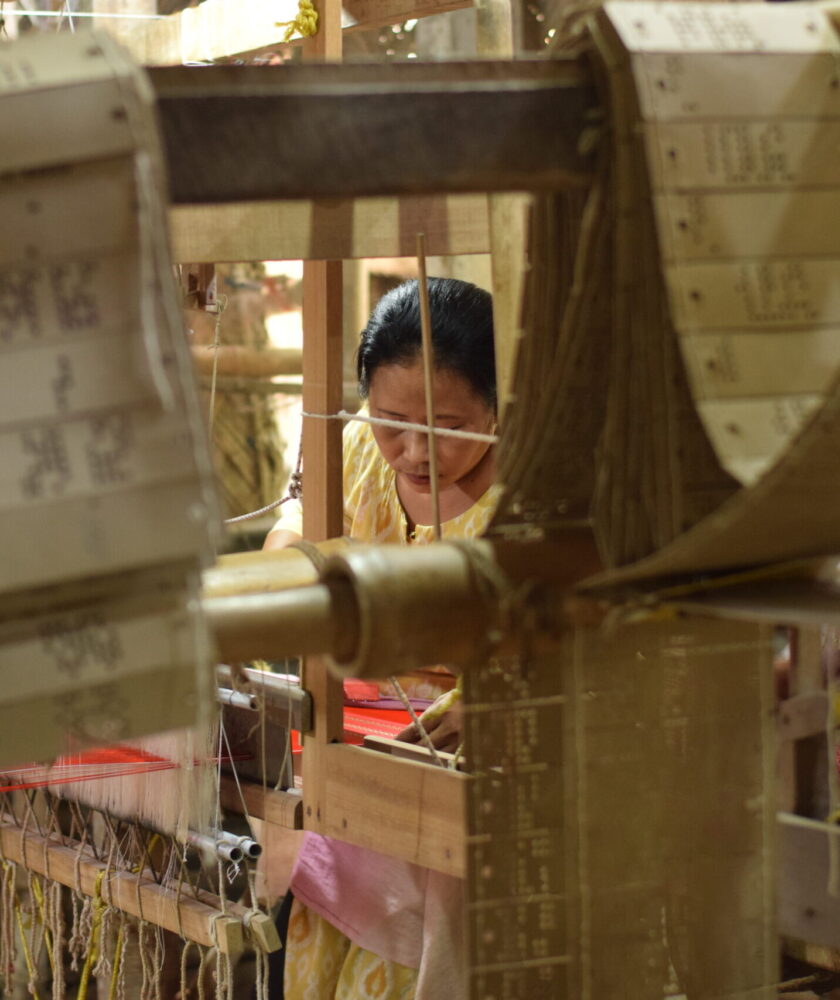
Weavers and Master weavers/Entrepreneurs are professionally engaged in Sualkuchi and are dependent on weaving activity for their livelihood. In most of the weaving sheds the working environment was not found to be conducive as there were insufficient lighting/illumination and ventilations. Looms are set up in a congested space without leaving any extra room for the weavers for relaxation. The ergonomic issues are also to be addressed to. Most of the Looms are frame Loom with Jacquards and Dobby. While Dobby units are 25 to 40 years old; Jacquard units are fairly modern. Looms are also sturdy and are customized to meet the specific requirement of the weavers.

The current prices of yarn at Soulkuchi are as under.

  • Muga Silk Filament yarn (Warp and weft): Rs. 45,000.00 –Rs.50,000.00 Per kg.

  • Mulberry Silk (Pat Silk): Rs.5,600.00 (Raw) to Rs.7,500.00 (degummed)per Kg. Degumming is done by use of Soda and soap.

  • Eri Silk spun Yarn: Rs.3,200.00 to Rs.5,500.00 per Kg depending on the fineness/count.

  • Tassar Silk Filament Yarn: Rs.7,450.00 to Rs.7,550.00 Per Kg.

  • Polyester Filament yarn: Rs.500.00 to Rs.700.00 Per Kg.

The issues of the cluster are increasing yarn prices resulting in increased cost of production and falling market share. Dyed yearns are sourced from Karnataka instead of dyeing at Sualkuchi now a days. The weavers do not stay longer with one Master weaver/Mohajan and they keep on shifting from one Master weavers/Mohajan to another with increased remuneration thus creating instability in the ongoing production process. The practice of organic dyeing is negligible. Of late some weavers/Entrepreneurs have introduced Eri silk yarn for weaving stoles etc. using vegetable dyes as these products are in demand in the market. Marketing of the finished product is problem in absence of any marketing linkages. Digital /Social Media Marketing is also not being followed by the producers. In order to have a better market share design intervention is required. Traditional designs are still produced to cater to the local market demands without emphasis on pan India Market.

Key Findings

The major technical issue found during the weaving process is yarn breakage. More than 70% of weavers are facing this problem.

  • Most of the weavers are not aware of the organic dyeing process.

  • They are not focused on adding finishing agents to the product.

  • There are many ergonomic stressors that cause fatigue and a lack of motivation to pursue weaving as a regular profession.

  • They are not professionally trained to deal with defects and defective products.

  • They are unable to forecast the demands and changing patterns.

  • Besides the above-mentioned issues, Handloom practice demands time, patience, concentration, motivation, skills, etc. Weavers are not happy with the wages they are paid for their work. They are demanding genuine wages which can motivate them to keep this heritage culture alive.

  • More than 80% of the weavers are unable to cope with the mental pressure and around 65% feel that they have to bear emotionally disturbing situations at work.

Final Deliverables

Design modification

  • Interventions in preparatory processes and in loom design aimed at enhancing productivity and operational efficiency.

  • Design and development of a technologically robust dyeing vessel with control over process parameters, enabling consistent and reproducible batch dyeing of yarn in hank form as well as continuous dyeing of fabrics.

Organic dyeing/finishing process

  • Eco-friendly natural dyeing-cum-finishing on handloom fabric by using Turmeric and Lac dye.

  • Improvement of wash durability of the dyed fabric up to 25 home laundering for increasing their market value and acceptance level in a wide class of people.

  • Evaluation and improvement of various functional properties (antioxidant, UV protective) of the natural dyed fabric.

  • Establishment of standard dyeing recipe and process for Eri Silk based handloom fabric using Turmeric and Lac dye.

  • Improvement of wash-fastness in pre-dyed yarn hanks (synthetic dyes) using alum mordant, without altering the initial colour values.

Ergonomics- component

  • Risk Factor Identification

    Risk factors leading to Musculoskeletal Disorders (MSDs) among the handloom weavers were identified by systematically analyzing their working postures and repetitive motions during various loom-based tasks.

  • Environmental Assessment

    Environmental variables, including temperature, humidity, airflow, noise, and illumination, were measured in field conditions over an entire year.

  • Impact on Well-being & Productivity

    Impact of environmental variables on worker comfort and productivity was assessed. Exposure to high levels of noise and low levels of illumination had a significant negative impact on weavers’ psycho-physiological well-being and work performance.

  • Ergonomic Interventions

    Design and implementation of an innovative seating arrangement, carefully aligned with traditional practices, enhanced postural comfort and reduced strain during long weaving sessions. Further, possible strategies to ameliorate the impact of adverse environmental conditions have been proposed, along with the distribution of LED lights to ensure the required level of illumination for intricate motifs weaving.

  • Implementation & Community Impact

    Through evidence-based interventions, we were able not only to propose but implement solutions that improved ergonomic safety, and occupational well-being of the weavers.

  • Scholarly Contributions

    The present research has produced three (03) research papers, out of which two (02) got accepted in an international journal and conference proceedings, and one (01) is under review in a reputed journal.

Personalised support and counselling

Over the course of this 3-year project, we have been deeply engaged with the weaving community, not only as trainers but as companions in their journey. By working closely with them in their villages, workshops, and homes, we delivered a wide range of support that combined skill building, health care, counselling, and digital literacy.

  • Awareness and Skill Development

    Conducted awareness camps across weaving clusters, where weavers learned how to read market demand, calculate the cost of their products, and interact with customers with greater confidence.

    Guided weavers on how to sell and promote their handwoven products through social media platforms, which was a completely new experience for many.

    Helped them understand and access government schemes, entitlements, and training opportunities that could support their livelihoods.

  • Health and Wellness Outreach

    Organised health camps in collaboration with RRIH & CCRAS (Ministry of AYUSH), registering weavers for OPD check-ups and providing much-needed medical support.

    Developed and shared wellness booklets that spoke simply about stress, mental health, and everyday care.

    Created exercise and yoga modules and shared them through a YouTube channel dedicated to the weaver community, so they could practice in their own time.

    Introduced relaxation exercises and yoga sessions during camps, which many reported as helpful in reducing physical strain from long weaving hours.

  • Personalised Counselling and Emotional Support

    Offered individual and group counselling sessions, both in person and through online/phone calls, so weavers could talk openly about challenges in work and life.

    Field awareness programmes became safe spaces where mental health, financial anxieties, and family concerns were addressed, alongside issues related to weaving.

  • Digital Literacy and Practical Tools

    Produced skill development booklets that weavers continue to use as ready references.

    Trained them on using Google Forms for simple surveys, giving them exposure to digital tools and confidence in data collection.

    Helped weavers prepare for market opportunities through structured training on pricing, branding, and customer engagement.

Approach & Methodology

A Relationship-Based Approach

  • This project was never envisioned as a short-term survey or a purely desk-based academic exercise. From its very inception, the philosophy driving it was relationship-building with artisan communities rather than mere data collection. The weaving sector of Northeast India is deeply personal and rooted in identity. To truly understand its challenges and opportunities, it was essential to immerse in the everyday lives of weavers. This required going beyond questionnaires and charts—researchers, trainers, and field staff lived with artisan families, observed their daily rhythms, ate at their homes, and joined them at their looms.

  • Such prolonged, trust-based engagement created an environment where artisans felt free to express their struggles and aspirations. The approach made them active contributors rather than passive respondents. Instead of being studied from a distance, artisans became co-creators of solutions, blending their indigenous knowledge with modern design, market, and technology inputs.

  • This relationship-based approach not only ensured authenticity but also helped in building a foundation of trust— something that is crucial in communities where traditional crafts have been neglected or exploited in the past.

Methods Used

The project employed a mix of qualitative and quantitative research techniques to create a holistic and evidence-driven understanding of the sector. Each method added a unique dimension to the knowledge base:

1. Field Surveys

  • Surveys were conducted across five major handloom clusters, reaching over 2,100 artisans.

  • Data collected included demographic details, income levels, working hours, occupational health issues, access to raw materials, challenges in design adoption, and exposure to markets.

  • These surveys established the baseline conditions of artisans and served as the foundation for measuring improvements during and after interventions.

2. Deep Interviews

  • Detailed one-on-one interviews with weavers, master trainers, cooperative members, SHG leaders, and handloom entrepreneurs provided insights that numbers alone could not capture.

  • Artisans spoke about the intergenerational transmission of skills, the pressures of low income, and the aspirations of younger weavers who often migrate in search of better livelihoods.

  • Such interviews highlighted the emotional and social fabric of weaving communities, helping researchers design interventions that were sensitive to cultural realities.

3. Ethnographic Observation

  • Researchers closely observed artisans in their natural environment—at looms, dyeing units, and during community gatherings.

  • These observations uncovered small but crucial details: posture-related health issues while weaving, frequent warp breakages during the shedding process, and the difficulty artisans face in repairing broken yarns.

  • This method helped capture the lived reality of artisans, which often remains invisible in survey data.

4. Market Studies

  • Parallel to artisan-focused research, market surveys and buyer interactions were conducted to understand current and future demand.

  • Studies analyzed domestic and export market trends, consumer preferences, and gaps between what artisans currently produce and what buyers expect.

  • This dual perspective—supply (artisans) and demand (markets)—ensured that interventions were economically viable and future-ready.

5. Pilot Trials and Field Testing

  • Instead of imposing theoretical solutions, the project carried out field trials directly in weaving clusters.

  • Prototypes and interventions tested included:

    Modified loom designs to reduce warp breakage.

    Natural dye recipes to minimize health hazards and appeal to eco-conscious buyers.

    Ergonomic seating and weaving tools to reduce back pain and strain.

    Design innovations that fused traditional motifs with contemporary aesthetics for broader markets.

  • These trials were conducted in collaboration with artisans, ensuring solutions were practical, cost-effective, and acceptable to the community.

Values Guiding the Methodology

Every stage of the project was driven by a set of core values that ensured both rigor and sensitivity:

  • Participatory

    Artisans were treated as partners in research and intervention, not as “subjects.” Their voices, feedback, and consent shaped every step of the methodology.

  • Respectful

    The project acknowledged weaving not only as an income-generating activity but as a cultural legacy and artistic expression. Interventions were designed with a deep respect for tradition.

  • Practical

    Solutions proposed were implementable in the real context of weavers’ lives. For example, instead of suggesting high-cost looms, modifications were designed to be made on existing equipment.

  • Responsive

    The methodology was dynamic and flexible, adapting to new challenges and community feedback. For instance, during the COVID-19 pandemic, interventions were adjusted to address disruptions in raw material supply and marketing channels.

Why This Approach Matters

This approach—rooted in participation, trust, and practical experimentation—moved the project beyond being an academic study. It became a living collaboration between researchers and artisans.

By combining large-scale surveys with deep ethnographic insights, and by testing solutions directly in the field, the project ensured that its findings were:

  • Relevant

    Directly addressing the needs and realities of artisans.

  • Implementable

    Focused on low-cost, adoptable innovations.

  • Scalable

    Designed in a way that they could be replicated across other weaving clusters of the Northeast.

  • Sustainable

    Balancing economic, cultural, and social dimensions of weaving.

By combining large-scale surveys with deep ethnographic insights, and by testing solutions directly in the field, the project ensured that its findings were:

Scroll to Top